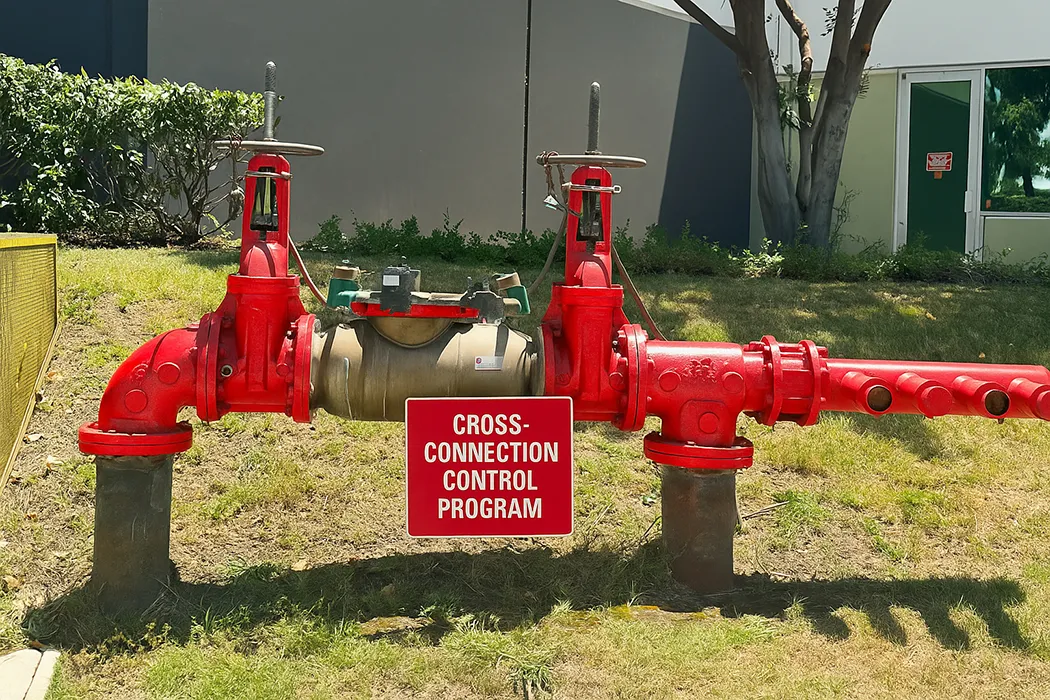
Cross-Connection Control Program
 Water Conservation
 Development
Program Forms & Resources
PROGRAM DESCRIPTION
Industry Public Utilities (IPU) is committed to delivering clean, safe drinking water that meets or exceeds all state and federal standards. To continue delivering on this promise, IPU has updated its Cross-Connection Control Program effective July 1, 2025. The program is in accordance with state and federal regulations, including the California State Water Resources Control Board’s Cross-Connection Control Handbook and IPU’s Industry Municipal Code Title 13 and Ordinance Number 557.
This proactive and comprehensive program is designed to identify, monitor, and reduce possible sources of contamination, ensuring continued protection of the public water system.
Purpose: IPU regularly tests and monitors the water it supplies to its customers to ensure we deliver on our promise. However, the safety of the water can be at risk due to potential cross-connections that may be located on customer properties. For this reason, IPU aims to take a proactive approach and locate potential hazards to protect the integrity of the water.
Program Goal: Find potential hazards throughout the service area and put protective measures in place to safeguard the public water supply and continue providing clean and safe water to customers.
Program Contacts
Alyssa Arana
(626) 330-2126
Cross-Connection Control Program Questions
Miguel Molina
(626) 330-2126
Shut off/restore water service during testing or repairs/replacement
CROSS-CONNECTION CONTROL ORDINANCE
IPU adopted Industry Municipal Code Title 13 and Ordinance Number 557, granting IPU the authority to implement and enforce a Cross-Connection Control Program (Program). This municipal code provides IPU legal authority to take corrective actions to protect the integrity of the water distribution system from actual or potential cross-connections. This includes instances when a customer fails to comply in a timely manner with IPU’s requirements regarding corrective actions or the installation, inspection, field testing, or proper maintenance of backflow protection assemblies (BPAs).
View Municipal Code Title 13 PDF
BACKFLOW TEST REPORT SUBMITTAL
Industry Public Utilities is committed to making the annual backflow testing process as simple and convenient as possible for our customers. This essential program helps protect our shared drinking water system and ensures safe, reliable water service for the community.
We sincerely appreciate our customers’ continued cooperation in completing the required annual testing.
For any questions, please email ba******@***********er.com or contact Alyssa Arana at (626) 330-2126.
ONLINE BACKFLOW SUBMITTAL FORM
Before you begin, please be sure to have the proper documents ready, as this form cannot be saved for later edits.
TESTER CODE OF CONDUCT SUBMITTAL
IPU will maintain a list of certified backflow testers, pre-approved by IPU the year prior, to conduct backflow assembly testing within the IPU’s service area. Customers may select backflow testers from this list.
Backflow testers may be added to this list at any time by signing and submitting the Tester Code of Conduct Form; however, the online Approved List of Backflow Testers Document will only be updated at the beginning of each calendar year.
Backflow testing forms will not be considered valid until the Tester Code of Conduct form has been received from that tester for the calendar year.
The backflow tester must sign and submit a Tester Code of Conduct Form at least once per calendar year. If a form has already been submitted for the current calendar year, an additional submission is not required.
ONLINE TESTER CODE OF CONDUCT SUBMITTAL FORM
SELECTING A BACKFLOW DEVICE
IPU does not direct customers which BPA to install.
Customers can select a BPA to install from the USC Foundation for Cross-Connection Control and Hydraulic Research: List of Approved Backflow Prevention Assemblies. The list provided on the following website is updated as changes occur:
Link to USC List of Approved Backflow Prevention Assemblies
IPU will ensure that each replaced or newly installed BPA (e.g., PVB, SVB, DC, RP, etc.) for protection of the public water system is approved through both laboratory and field evaluation tests performed in accordance with at least one of the following:
- Standards found in Chapter 10 of the *Manual of Cross-Connection Control, Tenth Edition*, published by the University of Southern California Foundation for Cross- Connection Control and Hydraulic Research; or
- Certification requirements for BPAs in the Standards of ASSE International current as of 2022 that include ASSE 1015-2021 for the DC, ASSE 1048-2021 for the DCDA & DCDAII, ASSE 1013-2021 for the RP, and ASSE 1047-2021 for the RPDA & RPDA-II and must have the 1YT mark.
HAZARD ASSESSMENTS
Industry Public Utilities is committed to keeping our shared drinking water system safe and reliable for everyone in our community. Because we all share the same water distribution system, it is important that we work together to prevent contamination and protect public health.
Some properties may have connections or equipment that could pose a potential risk to the drinking water system. Examples include horse stable water stations, industrial processing equipment, or chemical injection systems connected to irrigation lines. In these situations, additional protection—such as installing a backflow prevention device or providing an air-gap separation—may be required to ensure contaminants cannot flow backward into the public water system.
To identify and address any potential risks, IPU conducts Hazard Assessments of customer properties. These assessments help us determine whether protective measures are needed and allow us to implement solutions when necessary.
This program is required by the State Water Resources Control Board under the Cross-Connection Control Policy Handbook (2025). To complete these assessments, IPU may use customer survey forms, phone questionnaires, or brief on-site inspections.
We appreciate your cooperation as we work together to protect the safety and quality of our community’s drinking water.
CUSTOMER TIPS & EDUCATION
Keeping our community’s water safe and healthy is something we do together. While the District works hard to protect the public water system, customers also play an important role. If backflow happens, it could allow unwanted substances to enter the shared water supply. That’s why the District is sharing helpful steps you can take to prevent backflow and keep our water clean.
Definitions
| Term | Definition |
|---|---|
| Backflow | The reversal of water flow in your plumbing system due to pressure changes. |
| Backpressure Backflow | Occurs when water flow reverses due to higher pressure on the customer’s side, such as a hose submerged at the bottom of a pool. |
| Backsiphonage Backflow | Happens when water flow reverses due to a large water draw, for example, during firefighting operations. |
| Air-gap Separation (AG) | A physical gap in plumbing to prevent both backflow and backsiphonage. |
| Backflow Prevention Assembly (BPA) | A device installed after the water meter to prevent both backflow and backsiphonage. |
| Hazard Assessment | A survey to assess potential hazards and risks to the water supply. Hazards are categorized as: High hazard |
Customer Do’s and Don’ts
Certain everyday habits can unintentionally jeopardize the water supply.
Follow these Do’s and Don’ts to help prevent contamination:
|
DO |
DON’T |
|---|---|
| Leave the hose running in a spot that is above the water | DO NOT submerge a hose in water (for instance, while filling a pool) |
| Check that your toilet is outfitted properly with anti-siphon ballcock assemblies | DO NOT use toilets that are not outfitted with anti-siphon protection |
| Remove these toxic sprays after use and install a hose bib vacuum breaker | DO NOT leave a hose connected to pesticide or fertilizer spray |
| Call your water utility company to shut off your water supply to investigate the potential source | DO NOT ignore signs of potential backflow in your plumbing system |
Potential Warning Signs of Backflow
If you observe any of the following in your plumbing system, please contact a licensed professional plumber:
- Discolored water
- Visible debris
- Bad odors
- Low water pressure
- Gurgling noises
- Slow drains
- Bad taste
- Repeated leaks
Please notify the District immediately if there is a confirmed case of backflow or if you need your water service temporarily shut off.
Contact Information
Please reach out to the Cross-Connection Control Program Coordinator for any questions.
Alyssa Arana
626.330.2126
ba******@***********er.com.